This Post Is Less Than 1,000 Words

Andy Gray, senior editor at SI.com, didn’t realize the stir he was about to cause when he posted the following in response to massive editorial layoffs:

Following announcements of cuts at Yahoo, MTV,  Vocativ, and HuffPost — and FOX Sports dumping its entire editorial staff, regardless of talent or views — some folks had had enough, as their responses showed:

Of course, Gray oversimplified — an ironic mistake, given the topic — and he acknowledged it himself in a later tweet.

But his remarks cut deep, and the angered response of the many journalists I follow on Twitter showed.

I’m curious how many readers jumped to longform’s defense.  I write that not to be sarcastic or caustic, but to point to the problem it implies: that longform’s support is stronger among the profession than it is among the audience.

Even if that’s true, I’m going to stop short of oversimplification and avoid using this as a rationale for quick and broad slaughter of editorial positions.  The problem, like longform itself, is more complex than that.

First, a shout-out to the past I was fortunate to inhabit, unlike many of my younger colleagues.  In a pre-Internet age, because of the fewer information options, publishers could take risk with longform pieces in newspapers and (mainly) magazines, and it spoiled many of us.

That was not the only factor.  In broadcasting, the FCC enforced policies that supported “the public interest,” and those policies also promoted a culture where all media appreciated a sense of social responsibility.

It might sound overly romantic (and maybe it is), but back then, media outlets understood the balance between what the audience wanted and what the audience needed, and provided both forms of content.

Journalists were socialized to understand that hard news and analysis were the broccoli, and soft news was the ice cream, and the news media had a responsibility to provide a balanced diet.

From then until now, such policies have been eliminated, public stock ownership of media outlets has caused an obsession with short-term profits, and the Internet, while providing the technology to easily support longform, has instead reinforced and even hastened the decline in attention span. Audience members have been conditioned to hyperlink rather than reflect.

Thus, sports media executives are conditioned to respond quickly and simply to prop up profits, with no consideration of the responsibility to provide a variety of content.  And simple numbers prop up these decisions and reinforce the philosophy.

And with these video offerings being more Skip Bayless than Edward R. Murrow, the decline is even more depressing.

So where does that leave the longform, written word producers?  We discuss the audience for such pieces, even as we recognize that a high percentage of that audience came to the longform free of charge, without a financial commitment to the content.

From a local and a niche/team perspective, of course, sports media continues to find an audience, and many sites still exist that provide a variety of content, though directed at a specific interest group.

But from a national perspective, as long as the Jamie Horowitz’s of the world bank their genius on a strategy devoid of that earlier sense of social responsibility, the writers should consider themselves on their own.

That implies a challenge to the audience to support these longform-ers beyond finding the fewer and fewer sites that publish their work.

When will the downward spiral stop? When the support for longform transitions from journalists responding to a Web producer on Twitter, to audience members willingly subscribing to the sites that still support longform, and to the excellent writers being let go by these national outlets, wherever they end up.

The High Cost of Free Info

As news of the ESPN layoffs continues to roll in, it’s obvious that the “embrace debate” network is doubling down on the strategy. So many of those laid off by ESPN are among its best and most reliable reporters.

This development lines up with some thinking I’ve been doing about the evolution of news information. I’ve been wondering about why, with the Internet fulfilling its early promise to provide a variety of viewpoints and information, so many people stick to one viewpoint, reading and sharing and re-reading the same type and level of info, over and over again.

It happens in sports the same way it happens in politics

The reason I’m about to propose is troubling, because it makes me come off as arrogant and condescending.  That, plus it minimizes the mission of journalism programs like the one I teach in at Auburn.  But I also think it weighs in to what happened at ESPN today.

My fear is that many people in the audience, at their core, don’t want to deal with the complexity of information and arguments. They want it simple and to the point — to their point, reinforcing their viewpoints.

Within the realm of sports media, they do not want a lot of information about their favorite teams, athletes and sports. They do not want complex explanations of topics like concussions or college athlete compensation or race.

They want some guys (and a couple females) at a table yelling at each other about a couple of polarizing stories — over and over and over again. They want columnists to reinforce their emotions rather than challenge their intellects. They want the same rush from sports “news” that they get from sports.

For decades, a different form of simplification was provided by the news media, through a limited number of news outlets giving a similar roster of news stories about a similar range of topics. Be thankful that the news media in that day was acknowledged for its objectivity and its responsibility.

Now, the Internet throws so much at us, but at the same time, it gives us the power to access whatever we want from that information.  So what is our response? A large portion of the audience throws off that info and control, and begs for less.  They do not want to know both sides. They do not want to know the story behind the story.

And many out there are making a ton of money giving them that. Read Clay Travis’s take on today’s layoffs at ESPN. Of course the reasons are more complex than he writes. But a loyal segment of his audience eats it up, because it reinforces the simple answers they seek. And Clay knows they would prefer not to read the more complex causes behind cord-cutting and changes in media consumption.

So where is it all headed? As with anything media-related, it’s hard to say. We could be moving to a media economy where the information costs money, while the oversimplified debate junk food referenced above still streams for free.

If that is the case, and even to the extent that it is true now, I hope you’ll consider supporting those sites that employ the reporters generating the info that you consume — whether traditional newspaper sites or entrepreneurial efforts employing veteran reporters.

But for the present, know that many of those professionals, who worked in the trenches finding the information that enlightened our sports consumption, are now unemployed. Now we will find out how much the audience values the service that they provide.

John Carvalho is an associate professor of journalism at Auburn, where he teaches sports journalism courses and researches sports media history. His latest book, Frick*: Baseball’s Third Commissioner, is a biography of Ford Frick. It is available through Amazon by clicking here.  You can contact him at johncarvalho56@gmail.com. This and all blogs are available for reprint upon request.

Remembering Jack Simms

img_0061In the summer of 2003, I was on a weekend visit to Auburn, preparing to move down and join the faculty.

Trapped in Comer Hall parking lot by a thunderstorm, I called Jack Simms.  As we talked, I told him, “Jack, my goal in coming to Auburn is to be to my students what you were to us.”

That would be a huge challenge, because of what Jack meant to Auburn journalism and its students over his 18 years as department head and the years that followed.

For those of us privileged to be his students, he was the ideal professor, mentor and friend, and he made sure that the faculty members he brought on used the same approach.

Jack’s first year was my freshman year, so I benefited from his classroom instruction and his mentorship as I worked on The Auburn Plainsman.  But it meant even more, these past 13 years, to be his friend.

As we Auburn journalism majors graduated, and so many of us went on to distinguished careers and syndicated columns and front pages and Pulitzer Prizes, Jack was our most treasured cheerleader.

Yet he never talked about himself much.  We had heard about Iwo Jima, but it wasn’t until he showed me an unpublished manuscript within the past few months that I realized what he had experienced.  The manuscript refers to a point during the battle where Jack and a fellow Marine had gotten separated from their company, the result of poor communication.  Amidst the smoke, grenades, mortars and rifles, they still managed to rejoin their company, and he survived.

In class, he never mentioned how, as an AP reporter in Tampa, he talked himself aboard a rescue ship that was heading toward the site of a private yacht fire in which young people from several prominent New York families died.  Or how he also got aboard the ship that had picked up the survivors and interviewed them.  Or how he tossed his film from the ship to a co-worker standing on the dock after the rescue ship returned, dodging quarantine rules.  This was heroic journalistic stuff.

Having returned to Auburn, I got to spend time with Jack, whether at our Friday morning breakfast group or at various journalism gatherings.  If we had driven together to Birmingham or Atlanta for an alumni meeting, it meant sitting patiently (often with his wife, Jo), waiting while he talked individually to each student.  They meant that much to each other.

His decline was noticeable and worrisome over the past few months, but it had its moments.

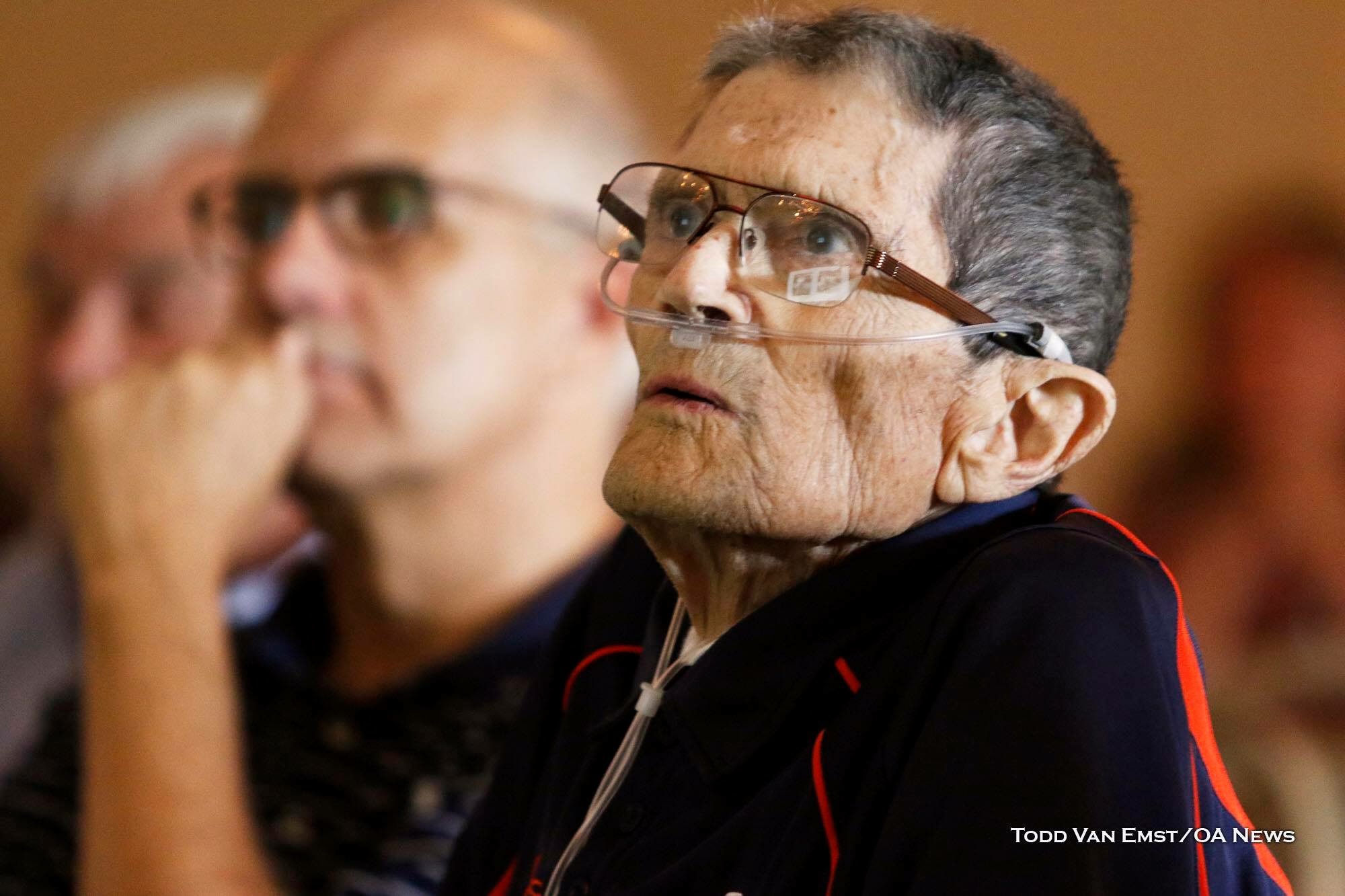
The first was his 90th birthday party, moved up to October to take advantage of the bye week.  (That’s where the picture above was taken.)  So many showed up, and Jack’s family did a great job of roasting him but also telling stories like the one above. And again he took the time to greet each guest and friend who approached.

The second was just three days ago, when Jack was brought to the field for the military appreciation halftime show.  He had told me earlier in the week that he didn’t know if he could make it, but he did, and accepted the crowd’s grateful cheers. And he still looked so darn rugged.

Those two, combined, would turn out to be our last chance to say goodbye to Jack.  We suspected as much, but it still made us glad and grateful that we were able to.

And now the torch has completely passed to those of us who learned from Jack.  Each of us fulfills his legacy in our own way — myself as director of the journalism program.

Intimidating?  A little, but not too much.  By his teaching, and by the example of his life, Jack prepared us well.