The Punt-Away Juror: How I Missed Being a Juror in the Mike Hubbard Trial

The verdict is in: I’m an idiot.

I could have been in the jury pool for the Mike Hubbard trial in Opelika.

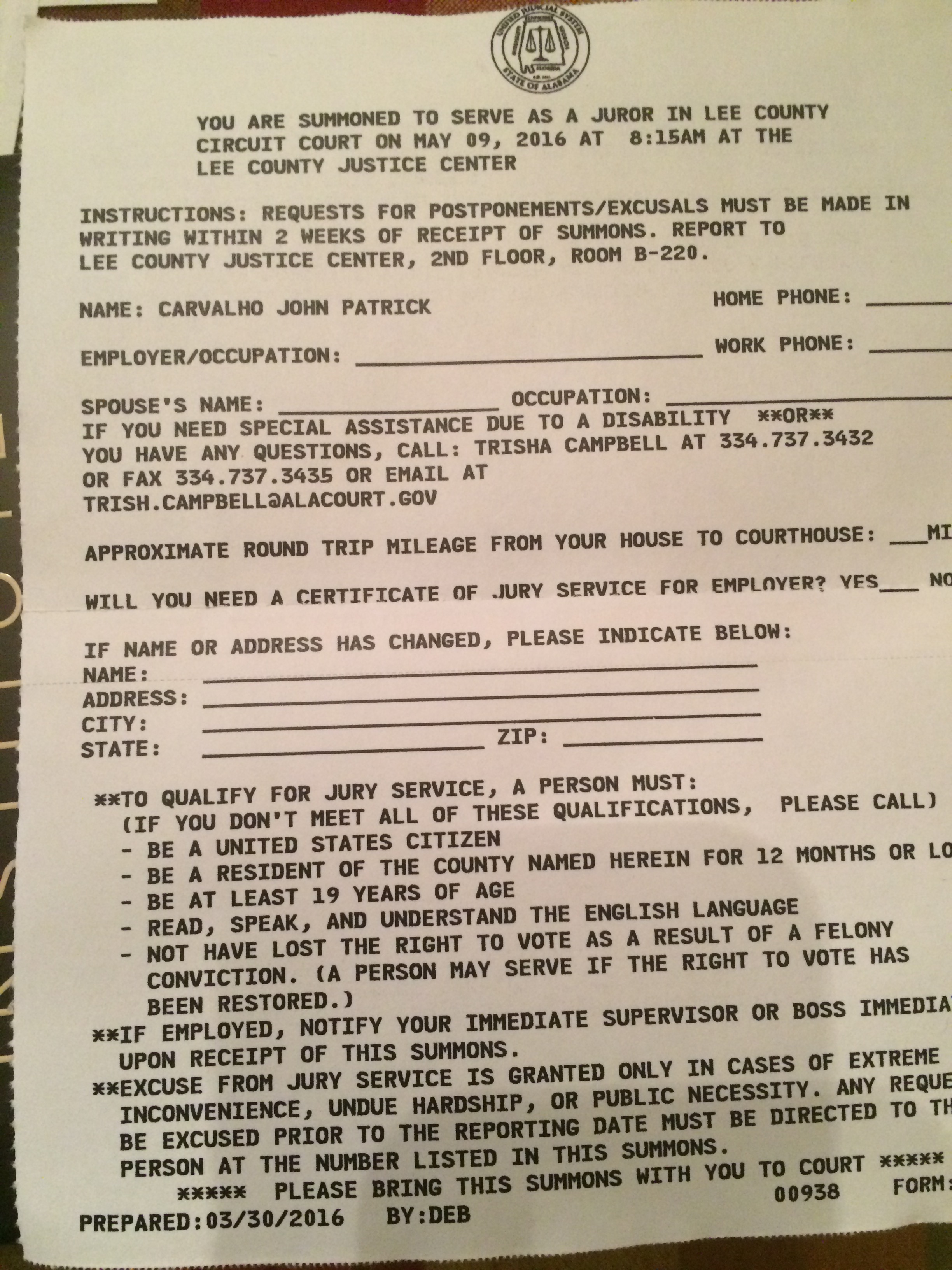
It all started when I received the following in early April:
IMG_0926

Could it be? The Holy Grail of Lee County trials? The trial of Alabama House Speaker Mike Hubbard on 23 felony charges related to ethics violations?

Mind you, my excitement related more to being part of an event, a happening, something historic.

Yes, I have read my own tweets about the evidence and the delays. I harbored no illusions.  But still; this would be awesome.

I realize that Judge Jacob Walker III had mentioned an earlier trial that he would need to clear out before the Hubbard trial could begin, so I was also prepared for that.

Then, a couple of weeks later, I received a juror’s questionnaire. A long one. Lots of questions about crime, politics, the courts.  And the questionnaire cautioned that the trial could last three weeks. That was the tip.

So I sent it in and then prepared myself. I stopped tweeting about the trial and talked about it only a little. I told a few friends, when it was relevant, about the jury pool thing. They thought it was funny too.

Then my stupidity set in.

First, let me plead prior experience — and while I do so, sound like one of my own students after missing a class event.

I had been called to jury duty twice when I lived in California. You were notified that you were in the pool, then the day before, you were contacted and told whether to show up.

Then, I noted in the papers that jury selection would begin on May 16.  Yes, I KNOW that I did not hear anything from Trisha Campbell, court administrator. Yes, I KNOW that my most recent official instructions said May 9.

So, after not getting a call I wasn’t promised, I did what any know-it-all professor would do. I didn’t show up. I looked forward to the fun on May 16.

Friday morning, at our weekly Chappy’s crew breakfast, I even asked Sheriff Jay Jones about parking. He told me it would be catch-as-catch-can, but he pointed out a couple of less-used parking areas.

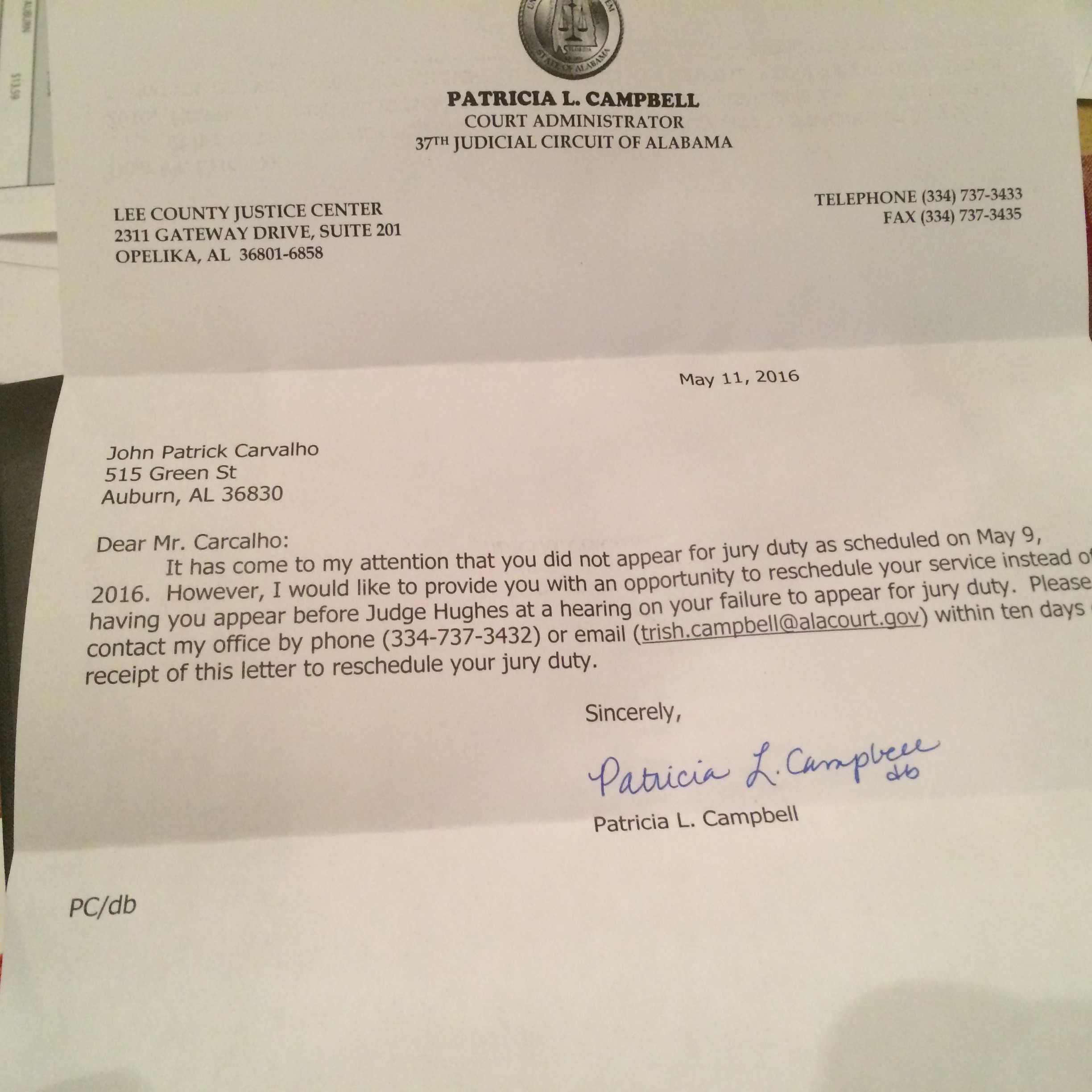
Then, the afternoon mail brought this letter:
IMG_0927

I was mortified, more than usual. When I teach Reporting, I take my students to cover trials at Lee County District Court.  Trisha Campbell and her assistant, Rebecca, have always been helpful to my students — letting us know which trials were at a better point for coverage.

And now, I had blown her off. I e-mailed her immediately and apologized.

So on Monday morning, while Alabama news hounds focused on the T.K. Davis Justice Center, I typed this blog.  I also served on the jury for a master’s thesis defense, since I had lost my excused absence.

I would not march into Judge Walker’s court with 100-plus other prospective jurors and hope that Elizabeth White (WTVM) or Katherine Haas (Opelika-Auburn News) would see me.

All because I am a too-cool-for-school idiot who can’t follow directions. Don’t look at me. It’s too hideous.

We went to Price’s BBQ house for breakfast, to soothe the hurt. There I saw Dr. Gerald Johnson, another Chappy’s regular and a former political science professor. He was disappointed. “You could have been a footnote to history,” he said. “Now you are a footnote to a footnote.”

Or maybe ignorant foot fungus to a footnote.

I seriously doubt that I would have ended up on the jury. They hear “professor,” they hear “journalism,” and if it were possible, a spring-loaded chair would have boing-ed me back to the catch-as-catch-can parking lot.


Plus, I hear that employment at Auburn disqualified a few prospective jurors anyway.

But I have learned my lesson. So I can announce: if anything comes of the charges against Gov. Bentley, Roy Moore, Hillary Clinton, Donald Trump, Queen Elizabeth, or anyone, I am willing to serve.

I’ve got this “show up at the correct date and time” thing down, I think.

Peyton Manning and One Shaky Source

One shaky source is making Peyton Manning’s life miserable.

The Al-Jazeera news network ran a report on the shady network of sports doping. Just past the 40-minute mark, the report — much of it undercover taping — shows a pharmacist claiming that he sent human growth hormone (HGH) to Manning in 2011, and that he addressed the packages to the Bronco QB’s wife to help hide the purchases.

The revelation was explosive and has led to angry denials by Manning himself. It has also touched off a huge debate about whether the 18-season veteran, one of the NFL’s most reliable role models, is instead a cheater.

My concern, as a journalism professor, is the unreliable nature of the Manning info. The Al-Jazeera report relies on one source — Charlie Sly — for the information, and Sly himself recants at about the 47:35 mark.

The report presents no receipts or correspondence, no second source acknowledging Manning’s involvement. Just one interview, with the source later presenting himself as flaky.

The NFL Sunday/social media blowup over this has exploded past this troubling detail, as can be expected. It is obvious that the majority of those commenting have not viewed the report itself, to see the thin ice supporting the information.

I’m not judging whether Manning used HGH. I’m wondering why a respected news organization released a news report before it was ready.

Al-Jazeera or another organization might come up with a second source (a more reliable source, I hope). At that point, the ethical question becomes, Why not wait? Why run the story before it’s ready? And responsible journalism ethical standards dictate that a story is not ready until you have a second source.

Does Manning have a case for libel? As a public figure, probably not — even though Sly’s recanting brings the information a little closer to “actual malice,” the definition of which includes “reckless disregard of whether (the information) was false or not.”

Plus, within the definition of public figure status, Manning has the means to dispute the report within the media, and he is obviously using them.

Can Sly, who is more of a private citizen than Manning, sue for invasion of privacy? It’s an interesting intersection between two conflicting rules. On the one hand, Al-Jazeera is safe on the issue of consent; Texas is a “one-party state,” meaning only one person needs to be aware of the taping.

On the other hand, previous Supreme Court decisions do not 100 percent permit deception in taping a private citizen or business, and the Al-Jazeera report was based on an athlete, Liam Collins, deceptively claiming he was looking for shortcuts, legal or not, to restart his athletic career. I don’t know whether this conflict has been resolved within the courts.

But from an ethical perspective, Al-Jazeera is on much shakier ground, and needed more corroboration before releasing information that so damaged one athlete’s reputation.

To contrast, I remember a mini-storm this summer, surrounding the death of legendary SEC/NFL quarterback Ken Stabler. A report on Stabler’s death July 8 was released on the Tuscaloosa News web site and then taken down quickly, but not before it was cited and the news spread nationwide.

The sports writer generating the report, Aaron Suttles, had a good source informing him that Stabler had died, but was awaiting a second one to confirm it before posting the article he had ready.  Due to miscommunication, a digital staff member posted the report.

Anyone who knows Suttles recalls his mortification and regret — not because the story was not accurate (obviously it was, as would be demonstrated), but because it was not “ready” in terms of sourcing, even as subsequent events confirmed the information’s reliability.

If only Al-Jazeera were so careful on a story that involves an active SEC/NFL quarterback, who now must deal with the public fallout of a shakily-sourced report. Manning, the audience, and the journalism profession deserve better.

Who Pays How Much to Sports in the SEC?

The Chronicle of Higher Education and Huffington Post collaborated on an excellent report, “Sports at Any Cost,” which looks at the high financial cost of sports, particularly to smaller schools trying to hit the so-called “big time.”

How does the SEC stack up?  I took the SEC data from a “College Sports Subsidy Scorecard” page they created and came up with this

Screen Shot 2015-11-16 at 5.59.38 AM

A couple of quick comments:

For institutions that do not rely on student fees, the money comes almost 100 percent from institutional funds, so the students would still pay the cost, but indirectly, through higher tuition, for example.

Vanderbilt University is not included, because it is a private institution and not subject to public records law.

LSU has committed itself to transferring $7.2 million/year from athletics to the general fund — the opposite direction of the subsidies portrayed in this article. In July, the university increased the transfer by $3 million for this year, given the funding crisis facing the university.