Auburn Is Not Liberty, and That’s Good

To begin, I will do something that on class assignments, would cause me to deduct points and make angry margin comments. I am going to summarize this column and generalize my thoughts up front.

This is intended as praise, so far, for how Auburn and Coach Hugh Freeze are working through a difficult and crucial issue. You might assume otherwise, but only because of the complexities involved. So, keep that in mind and here we go:

Jarquez Hunter’s absence from the opening of fall drills is reassuring to those of us who wondered how Freeze would handle issues related to alleged sexual misconduct involving football players. In this case, it is being taken very seriously, and that’s positive.

Back to the disclaimers. First, this is not a discussion of the Hunter case itself. The details alone are complex, and no one outside of those directly involved has all of them. And I confess to struggling with how to categorize the situation; “alleged sexual misconduct” was my best go.

Still, the actions contrast with what happened during Freeze’s tenure at Liberty, when players under Title IX investigation played in Liberty football games, and in his final season (2022), a starting tight end who was arrested for stalking faced no repercussions, even after he violated Freeze’s and the court’s instructions not to contact an ex-girlfriend.

At the very least, Auburn fans can take heart in one conclusion: Auburn is not Liberty University.

Granted, Freeze was under different leadership at Liberty. When he arrived in Lynchburg, Liberty was going full toxic under Jerry Falwell Jr., whose style would inevitably lead him high-speed into a brick wall of humiliation. And Freeze’s AD was Ian McCaw, who seemed to have imported the permissive attitude at Baylor to Liberty when it came to sexual misconduct investigations.

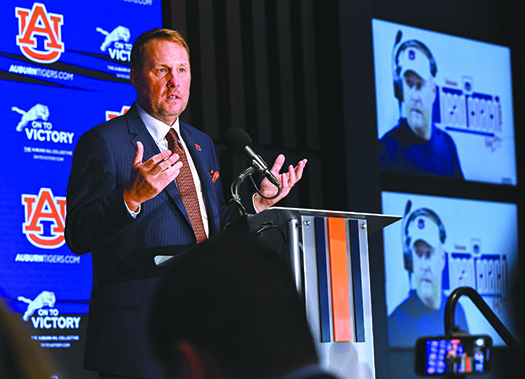
When Freeze was announced at head coach at Auburn (pictured above), some of us within the community balked. While the college football media focused on Freeze’s tone-deaf social media interactions, and his transgressions at Ole Miss, the aforementioned cases at Liberty were troubling in a different way.

The Daily Beast mentioned the Title IX cases in a broader indictment of Falwell’s tenure*, while the Jackson case was mainly reported in the local newspapers and barely discussed beyond that. (*–A warning about the DB article. The title might make you think it’s about football, but it was mainly a vehicle for the author to promote a book he co-wrote with the “pool boy” at the center of Falwell Jr.’s scandal. Info on the football team is there, but scant.)

Thus, when Freeze moved from Liberty to Auburn in November 2022, there was concern that, besides all the other baggage, he would bring a permissive, protective atmosphere to the team. This happened at the same time Auburn declined to make sexual misconduct complaint data available for a USA Today report. That more than 100 schools participated and only five other schools declined was a bad look.

The concern moved Auburn President Chris Roberts to e-mail supporters and alumni and assure them that the school would continue to protect its students from such “power-based personal violence or abuse,” and outlining the safeguards in place, as reported in the Opelika-Auburn News and other outlets.

This is all in the past, however, as the handling of Hunter’s case reflects. Auburn is taking this situation seriously, and that is a good look. It would be constructive for Freeze or AD John Cohen to publicly acknowledge a commitment to the safety of Auburn’s women within such cases, but that’s their option.

At least their commendable actions are speaking louder than words. Fans might be eager to see a top player back on the field, but the process of investigation is more important. Still, it’s reassuring to see that Roberts is not Falwell Jr., Cohen is not McCaw, and Auburn is not Liberty.

For Love of the Game … and Auburn

A few years ago, our season tickets were near the top row of the northern end zone. As one OOC easy victory winded down, we started to leave.

The stands were quickly clearing out, but I saw a father and son still in their seats, in Auburn jerseys and hats. As they watched, the father was explaining the game to his son.

To many of us, this was a rest stop between important games and an excuse for an early escape. My guess was that for these two Auburn fans, it was their best chance to get affordable tickets, and a moment that they were going to share until 0:00.

Now, during at least one of those games, I like to wander our section and see if I can find some fans like that. College football has become a high-ticket juggernaut all around, pricing itself out of reach of many fans.

But these fans came to watch Alabama State, and they shared a moment. I’d like to introduce you to a few of them.

(Before I do, I promise to put to rest the “sidewalk alumni” snobbery from here on out. A lot of these folks did not go to Auburn, but they are still fans. They are family.)

This is Burt from Leeds and his three kids. Mom is at home; No. 4 is a month away.

Burt has been coming to Auburn games since he was 7, during the Pat Dye era. His father worked with coach Rodney Garner’s father.

(And check out his son’s Auburn socks.)

Burt and his kids also brought good luck. I was walking to the game as I met him, and we scored a ride on a cart. That also meant they got there in time to see the eagle fly.

This is Tony (right), his brother, Devin, and their niece, Shay, from Notasulga.

Tony sat in front of us and had a great time talking football during the game. He got his tickets through a friend who was working the game.

That is a Notasulga jersey Devin is wearing. He told me that he is a fan of both Auburn and Alabama. Good luck with that.

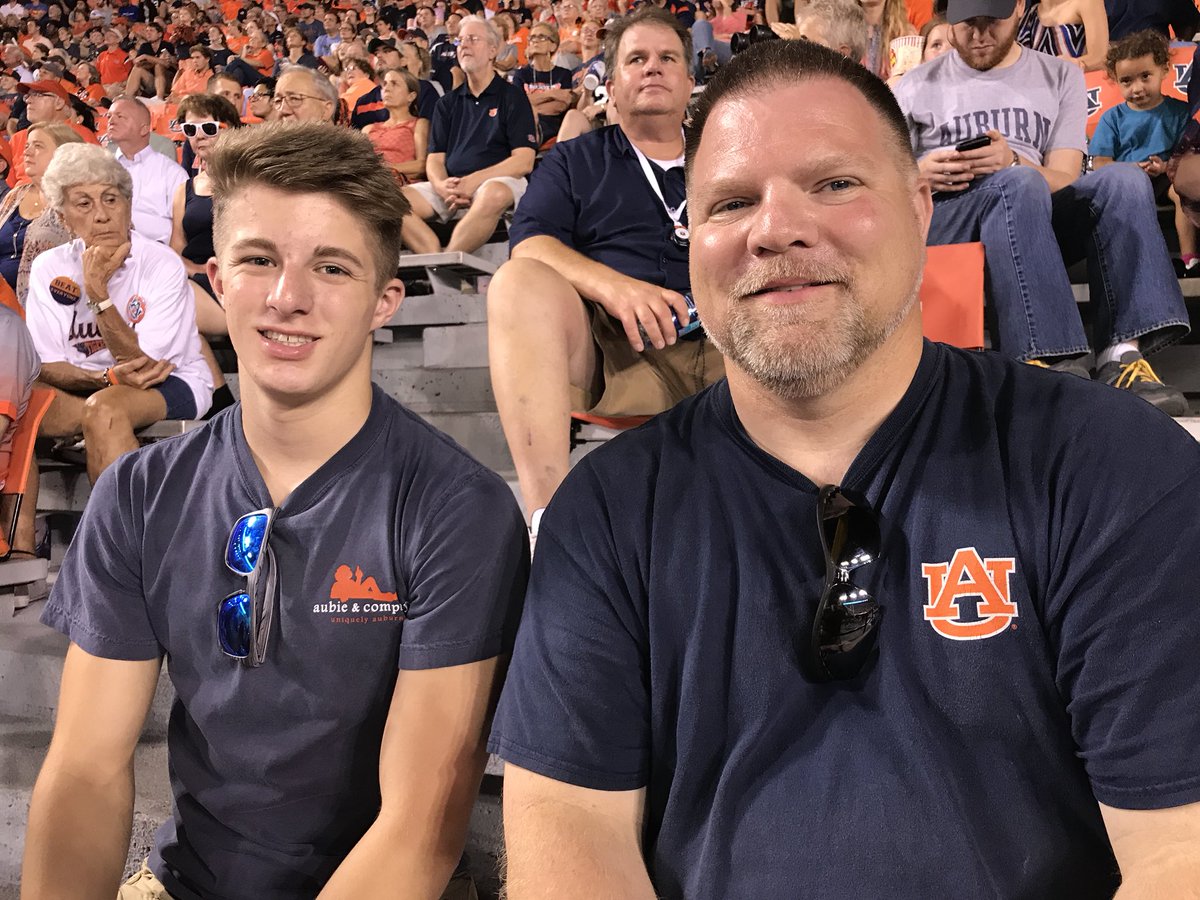
This is John and his son, Max, from Prattville.

John got his tickets through his boss. They might have moved down from the upper level to these seats.

Note the matching Auburn t-shirt/sunglasses combo. Sharing Auburn style to go with their Auburn fandom.

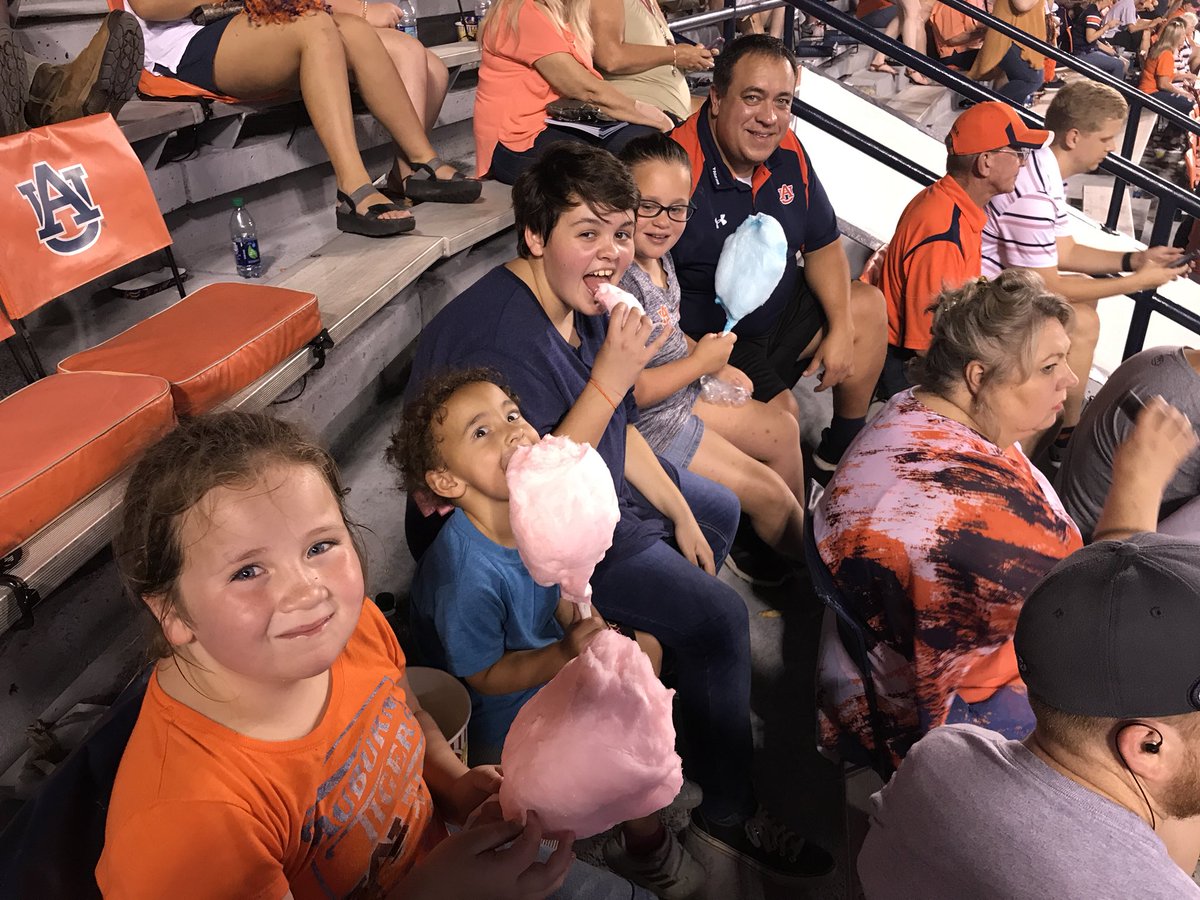
This is Chris, from Canton, Georgia. He brought four young ladies with him.

His daughters are on the outside; his nieces are the two on the inside. Chris had just made a major investment in cotton candy.

It was the nieces’ first Auburn game. When the older one heard I taught journalism, we talked writing for a while. We might have recruited an English major. Make that two — his daughter sitting between us is a reading fanatic.

This is Daniel and his son, Dawson, from Heflin. Daniel also got his tickets through his boss.

Daniel is an Auburn fan, but his sport is basketball, so we also talked Bryce Brown and Austin Wiley.

While I was talking to them, Auburn fumbled a punt that led to Alabama State’s only touchdown.

I feared my project was bringing bad luck, but Daniel assured me that the game was well in hand.

One father did decline to participate, which is totally acceptable, of course. I approached them because his son was taking a selfie of them with the game behind them. Dad explained, “That was for Mom.”

I also talked to a mother and son who sat next to me in empty seats early in the game. It turned out they have season tickets, but they gave them to other fans so they could help a friend with her food booth. They were sneaking out for a break to watch part of the first quarter. Hash tag Busted.

Disclosure: Given the late starting time and long drive home, not all of these folks made it to the alma mater. But they were able to spend a day together, sharing in the Auburn football experience and its memorable moments.


Keep the Foy Trophy, Remember the Foy Legacy

The careless debacle that was Wednesday night’s Foy-ODK Sportsmanship Trophy presentation was sad on so many levels.

What’s saddest is that the actions by the participants reinforced a lack of awareness of who Dean Jim Foy was and what he represented — a memory the trophy is supposed to preserve.

First, let’s talk about Dean Foy. He was born into an Auburn family, but graduated from Alabama. His family moved to Tuscaloosa after his father died, and he worked three jobs to finance his education there. He and Bear Bryant were Sigma Nu pledge brothers.

He became dean of men at Auburn in 1950, a title later modified to dean of students. Foy served 28 years before retiring in 1978.  I was honored to serve as Plainsman editor his last year; he allowed us to break the news of his retirement.

He was known for leading War Eagle cheers (particularly in a weekly competition on Fridays with the Student Union staff), but also helped guide Auburn through integration and the social upheaval of the 1960s and 1970s.

But more than that, he used his background and life as a model for toning down the Auburn-Alabama rivalry and encouraging it toward sane boundaries.

As so often happens, however, his legacy has been forgotten by succeeding generations of students.  When the new Student Center opened in 2008, many of us alumni lobbied to have it named for Dean Foy, as the Student Union had been.

The SGA Student Senate considered a resolution supporting it that year, but the resolution was voted down after the SGA president at the time spoke against it. She urged the Senate to give the University flexibility to find a naming sponsor or donor.

Ten years later, it is still merely the Student Center, with Dean Foy’s commemoration limited to the information desk instead of the entire building. He deserves more.

Then, on Wednesday, the trophy named after Foy suffered through yet another ceremony that ignored his legacy. First, the Alabama SGA president made a speech that included a dig at Auburn, noting the six national championships that had been brought to the state since 2009. And Auburn fans, you’re not off the hook for booing her, either.

The tradition is for the Alabama SGA president to lead the singing of the Auburn fight song, to commemorate the winner of the Iron Bowl. It would have been a great opportunity for the Alabama SGA president to cite Dean Foy’s example and follow the tradition. (It would have changed the boos to cheers.)

Instead the Auburn SGA president took the mike and directed the singing to begin — one politician letting another off the hook. It is ironic that the two SGA presidents did work together, but in undermining the legacy intended by the ceremony.

It’s natural for college students to enjoy the traditions of their schools, even as they rush past the individuals who laid the foundation. I have no doubt that my generation was guilty of this as well.

We should do better, however, and honor these traditions in a way that shows our gratitude.

Many wonder if the ceremony should be dumped. That would be the ultimate dishonor to Dean Foy. Why not challenge both SGA presidents to restore the ceremony’s original intent and use it to remind the fans of both schools of Dean Foy’s legacy?

Some reflection and intent are needed. Otherwise, halftime of the Auburn-Alabama basketball game will be marked by a ceremony that is more Updyke than Foy, regardless of who wins the Iron Bowl.

John Carvalho is a professor of journalism at Auburn. He graduated from Auburn in 1978.